Your Essential Guide to GST/HST Registration
Contents
Share
So, you’ve started your business and are selling your products and services, but do you also need to consider GST/HST registration?
What are the rules? Do you have to register for it now, or can you wait? Would you want to register for it even if you didn’t have to?
We’ll go through step by step and discuss what GST/HST is, what the rules are, and how to register.
This article discusses GST/HST registration, which applies to most businesses. There are additional GST/HST registration rules for the following organizations, which this article doesn’t discuss.
- Taxi operator or commercial ride-sharing driver
- Non-residents
- Charities and public institutions
- Public service bodies
What Is GST/HST
Goods and Services Tax (GST) and Harmonized Sales Tax (HST) are the taxes charged on goods and services purchased in each province in Canada.
GST is charged in Alberta, British Columbia, Manitoba, Northwest Territories, Nunavut, Quebec, Saskatchewan, and Yukon.
HST is charged in Ontario, New Brunswick, Newfoundland and Labrador, Nova Scotia, and Prince Edward Island.
HST includes the federal and provincial portions of sales tax into one amount, whereas provinces that charge GST have a separate provincial sales tax (PST) or no PST at all. Quebec charges Quebec Sales Tax(QST) rather than PST.
The GST/HST rules apply to both sole proprietors and incorporated businesses. If you are registered for GST/HST as a sole proprietor and then incorporate your business, you will need to register for a new GST/HST number under your corporation’s name.
The following table shows the current sales tax rates in each province in Canada.
Taxable, Zero-rated, And Exempt Supplies
Understanding the difference between these types of supplies is essential when determining your GST/HST registration requirements.
Taxable supplies are goods and services subject to GST/HST when sold from a business to its customers.
Zero-rated supplies are taxable supplies that are taxed at a rate of 0%. Even though you don’t collect GST/HST on these supplies when they are sold, you can still claim input tax credits (ITCs) on the costs of providing these supplies to customers.
Exempt supplies do not have GST/HST charged on them at all. Generally, you are not allowed to claim ITCs on the costs of providing these supplies to customers.
When To Register For GST/HST
So, when is the time to register for GST/HST?
Two criteria determine if you must register for GST/HST. They are:
- You exceed the $30,000 threshold either:
- In one calendar quarter or
- over the four previous calendar quarters, but more than one calendar quarter.
- You make taxable sales, leases, or other supplies in Canada
- This does not apply to sales of real property sold other than in the course of business.
Generally, if you are a small supplier, meaning your business earns $30,000 or less of revenue over four consecutive calendar quarters, you are not required to register for GST/HST.
The $30,000 threshold is the total amount of revenues (taxable supplies + zero-rated supplies) from your worldwide taxable supplies from all your businesses and associates. So, if you’re starting a new business, be sure to consider any other revenues from other businesses or associates as you may need to start charging GST/HST sooner than you think.
Note that some supplies require immediate GST/HST registration, even if you are below the $30,000 threshold.
- Taxi operator or commercial ride-sharing driver
- Non-residents carrying on certain business activities in Canada
You can find out more about these exceptions here.
You can also voluntarily register for GST/HST if you are a small supplier. But remember that once you have registered for GST/HST, you must start collecting GST/HST even if you are still below the $30,000 threshold. We’ll discuss the reasons why you may want to do that shortly.
The CRA uses calendar quarters when determining whether your business is required to register for GST/HST. So, the calendar year is split into the following quarters:
- January – March
- April – June
- July – September
- October – December
If your business starts operating in August, quarter one for GST/HST registration purposes would be July – September.
Mandatory GST/HST Registration
It is important to monitor your sales throughout the year to identify if you’ve reached the threshold and are required to register for GST/HST.
Once you meet the two criteria above, it’s time for your business to register for GST/HST.
Your sales exceed $30,000 in a single calendar quarter
If your sales exceed $30,000 in a single calendar quarter, you are no longer a small supplier and need to charge GST/HST on the sale that made you exceed the $30,000 threshold.
Your effective date of registration is no later than the date of the sale that made you exceed the $30,000 threshold. You have 29 days from your effective date to register for GST/HST.
Example
You start a business on February 1. The following is the revenue earned in the first three quarters of operating your business.
In quarter three (July-September), you earned $35,000, which is over the $30,000 threshold. This means you are required to register for GST/HST. The sale that put you over the $30,000 threshold was on September 2. On September 2, you are no longer a small supplier and must charge GST/HST on that sale.
Your effective date of GST/HST registration is September 2, and you now have 29 days from September 2 to register for GST/HST.
Your sales exceed $30,000 over the four previous calendar quarters
If you exceed $30,000 over the four previous calendar quarters, but more than one calendar quarter, you are no longer a small supplier and must register for GST/HST.
Your effective date of registration is no later than the beginning of the month after the sale, which made you exceed the $30,000 threshold. You have 29 days from your effective date to register for GST/HST.
You need to start charging GST/HST on your effective registration date.
Example
You start a business on February 1. The following is the revenue earned in the first three quarters of operating your business.
This is similar to the previous example, but instead of earning $35,000 in quarter 3, you only earn $29,000. You no longer exceeded the $30,000 threshold in one single quarter, but you have exceeded it over three continuous quarters.
In this case, your effective date of GST/HST registration is November 1 because it is the beginning of the month after the quarter you exceeded the $30,000 threshold. You would have to start charging GST/HST on sales from November 1 onward. You have 29 days from November 1 to register for GST/HST.
Voluntary GST/HST Registration
Your sales are less than $30,000 over four consecutive quarters
If your sales are less than $30,000 over four consecutive quarters, you are considered a small supplier and are not required to register for GST/HST.
However, you can voluntarily register for GST/HST even if you are below the $30,000 threshold. Your effective date of registration is usually the day you request to open your GST/HST account.
You may wonder why you would want to register for GST/HST if you don’t have to. Yes, it does require some additional administrative work, but some benefits may make it worthwhile to you.
- As a small business, charging GST/HST can make you look more professional in the eyes of your customers.
- It also simplifies your future growth as you no longer have to monitor whether your business has exceeded the $30,000 threshold.
- The most appealing reason may be that you can claim the GST/HST you pay on your business expenses. When you are just getting your business up and running, your expenses will likely exceed your revenue, which could result in GST/HST refunds in the beginning.
Again, remember that once you are registered for GST/HST you must start charging your customers GST/HST, even if you are below the $30,000 threshold.
How Complete The GST/HST Registration Process
If you are a sole proprietor or corporation operating in any province except Quebec, you will register for GST/HST with the CRA.
If your business location is in Quebec, you will register for GST with Revenu Quebec.
There are a few ways to submit your GST/HST registration with the CRA.
- The quickest way to register for a business account is to use the CRAs Business Registration Online (BRO) service. Once you register for a business number, you can continue in the same session to register for a GST/HST number.
- You can call the CRA business enquiries line at 1-800-959-5525.
- You can complete the RC1 form and mail it to your tax service office.
If you are registered for GST/HST as a sole proprietor and eventually incorporate your business, you need to register for GST/HST under the corporation’s name.
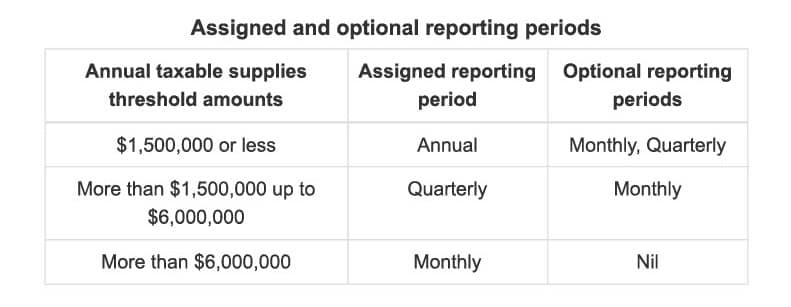
GST/HST Reporting Periods
The following are the default and optional reporting periods for filing your GST/HST returns with the CRA.
Common GST/HST Registration Mistakes To Avoid
Being registered but not collecting GST/HST on sales
Once your business is registered for GST/HST you must collect GST/HST from customers and remit it to the CRA.
If you are registered for GST/HST and do not collect GST/HST from customers, you are still responsible for remitting the GST/HST that would be collected on those sales.
You can attempt to go back to customers and ask for the GST/HST that should have been charged on their transaction, but they are not obligated to do so.
This is why it is so important to accurately determine the date you need to start collecting GST/HST on your sales so you do not become responsible for any of it yourself.
Failure to File
It’s important to remember the deadlines for filing your GST/HST return.
If you are registered for GST/HST and fail to file your return for a period, you could receive penalties and interest. However, if there is $0 owing or the CRA owes you a refund, the CRA does not charge you penalties or interest.
There are a few types of penalties applied to GST/HST returns, depending on the situation. A common one is the failure to file penalty. The calculation to determine the penalty is:
1% of the amount owing + ( 25% of the 1% of the amount owing x the number of complete months the return is overdue, to a maximum of 12 months)
Example
CRA penalties cannot be claimed as an expense to reduce income tax. However, if you file your return late and receive refund interest from the CRA, you must claim this interest as income on your income tax return.
Not saving the GST/HST collected to remit to the CRA
This is easy to do when the GST/HST you collect is just included in your business chequing account. You may draw the money out for yourself or buy new equipment to replace old equipment, but when it comes time to file your GST/HST return, there’s not enough money in your account to pay the balance due.
Consider setting up a separate account to save the GST/HST collected until it is time to remit it, especially if it is a significant amount. This can ensure enough money is set aside to pay the balance on time and not incur interest on a late payment.
Additional Resources
If you are uncertain about how a supply should be treated for GST/HST, which rate you should be charging, or if you are eligible to claim ITCs, you can contact the Excise and GST/HST Rulings Interpretations Service to get a ruling. This is a free service offered by the CRA.
Conclusion
Understanding the GST/HST registration process is crucial for any Canadian business owner to ensure compliance with the CRA and avoid penalties.
GST/HST registration becomes mandatory once your sales exceed the $30,000 threshold within a single or consecutive calendar quarters, but you may also opt for voluntary registration to claim input tax credits and present a professional image.
Regardless of your decision, it’s essential to monitor your sales closely, understand the types of supplies, and be prepared to manage the administrative responsibilities associated with GST/HST registration and filing.
Proper planning will help avoid common mistakes like failing to collect or remit the appropriate amount of GST/HST to the CRA.
We also have blog articles on the GST/HST place of supply rules, the quick method of accounting for GST/HST, and deadlines for filing GST/HST returns. These are great resources if you are looking to learn more about GST/HST.