The Advantages And Disadvantages Of Incorporating

Contents
Share
Congratulations! You've taken the plunge and started a business. Going out on your own can be overwhelming and there are so many things you need to figure out when you start walking down this path. One of the questions you should ask yourself is: Do I need to incorporate my business? Each business and owner will be different, so it really depends on your own situation to determine the best option.
Some questions that should be answered before incorporating are:
- Is my business at risk of being sued?
- Am I earning more money than I need to live on?
- Do I plan on selling the business or transferring it to my children in the future?
- Do I plan on borrowing money or selling shares to investors to grow the business?
Once these questions are answered, you will have a better idea of which direction to go.
Advantages Of Incorporating
Limited Liability
When you incorporate a business, it becomes a separate legal entity and can protect you from personal liability. It can provide protection from creditors and from judgements against your company due to legal action.
If you operate as a sole proprietor, then your business is an extension of you. Any debts incurred by your business or any legal judgements against your business are your responsibility as an individual to settle. This means that all your business and personal assets are at risk in these situations. Your level of risk will depend on the type of business you operate.
Incorporation doesn't completely protect you from personal liability. The disadvantages of incorporating section below cover some of the common areas where you could still be personally liable for.
Lower Tax Rates
If your business makes more money than you need to live on, then incorporating your business could result in tax advantages that wouldn't be available to a sole proprietorship.
Suppose you require $50,000 a year to live on but the net income of your business is $100,000 per year. As a sole proprietor you are paying personal taxes on the full $100,000 at your marginal tax rate.
When your company is incorporated you can pay yourself a $50,000 salary and keep the remaining $50,000 in the business to be taxed at a lower rate (currently 11% in BC in 2021). The example below shows the savings from incorporation.
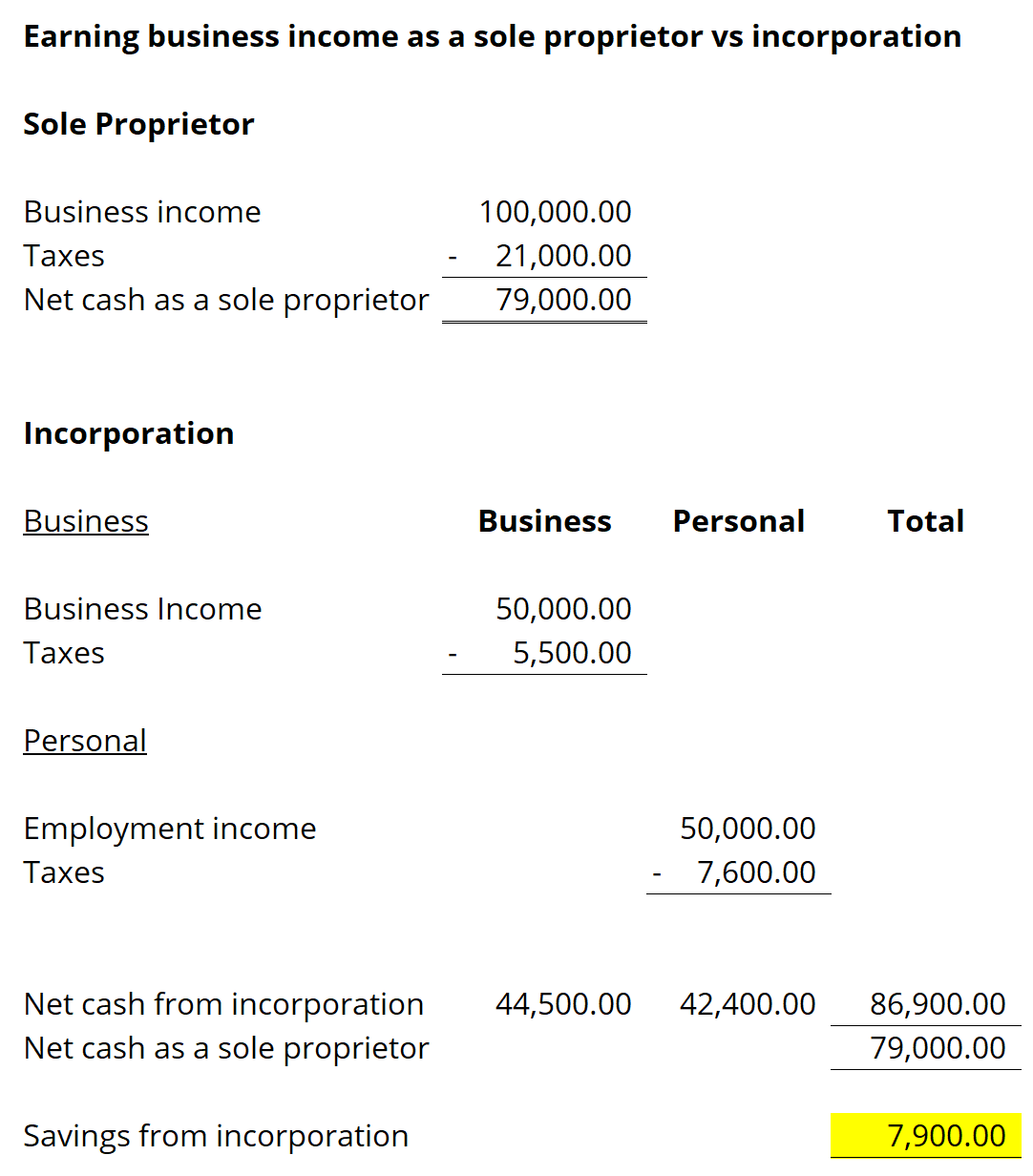
British Columbia personal and corporate tax rates are used in this example.
The benefit is that the money you didn't require to live on is taxed at a lower rate so there is more business income after tax inside the corporation that can be used to grow your business. As a sole proprietor, you would have had $7,900 less to invest back into your business.
The reduced tax rate in a corporation is enjoyed by Canadian Controlled Private Corporations (CCPC's) that qualify for the small business deduction (SBD). The SBD is a 19% tax credit on the first $500,000 of active business income of a CCPC.
As a result of incorporation, you will have more money left after tax to spend on growing your business.
Once you incorporate a business, you'll need to determine how you are going to pay yourself, salary or dividends.
A Corporation Is A Separate Legal Entity
A corporation is a separate legal entity from the shareholder(s) so it can continue to exist regardless of what happens to its shareholder(s). This makes it easier to sell the company than if you remained a sole proprietor. You can also plan for the future by passing on the company to other family members if desired. A business left as a sole proprietorship would cease to exist when you pass away. This adds flexibility for long term planning of your business.
Lifetime Capital Gains Exemption (LCGE)
If you are building a business that you intend to sell one day, then the LCGE could save you a significant amount of tax when you go to sell your shares.
The LCGE provides an exemption ($913,630 for 2022) on capital gains from the sale of a Qualified Small Business Corporation (QSBC). There are 2 tests which need to be met in order to qualify for the LCGE.
- Share ownership
- For the 24 months prior to the sale of shares, the shares must have been owned by either the individual selling the shares or a person or partnership related to them.
- Use of business assets
- For the 24 months prior to the sale of shares, more than 50% of the fair market value of the assets must have been used in active business primarily in Canada.
- At the time the shares are sold, 90% or more of the fair market value of the assets must have been used in active business.
There are some assets such as stocks, bonds, real estate, and shareholder loans that may result in the failure these tests, so it is important to be aware of the requirements long before you sell your shares to make sure you qualify.
Business Name Protection
Incorporation provides protection to your business name so that nobody else can use your business name. As a sole proprietor, you can register your business name, however, it may not protect you from an incorporated company from using the same name.
Provincial incorporation protects your business name in the province or territory you incorporate in. If your business expands its operations into another province or territory you will need to get the business name approved there as well since a company in that province or territory may have the same or similar name to your company.
Federal incorporation protects your business name throughout all of Canada, so you don't have to worry about another business having the same name in another province or territory.
One thing to keep in mind with both types of incorporation is that you will need to register as an extra provincial company if your business expands into another province or territory. This means that a federally incorporated company will need to register as an extra provincial company in the province or territory of its head office since it isn't incorporated in any specific province or territory.
Disadvantages Of Incorporating
Incorporation Costs
It can be quite expensive to have a law firm prepare and file all the documents necessary to set up your incorporated business properly. There are online options for incorporation that are cheaper, but some may not provide the full incorporation process which may cause problems for you in the future. The benefit of having a lawyer incorporate your business is that it will be set up correctly and legally preventing any potential issues down the road.
If there will be more than one shareholder then shareholders' agreements should be prepared by a lawyer. It is important to have shareholder's agreements that set out the rights and obligations of the shareholders and how to deal with specific situations in the future should they arise. For example, it can define what happens when a shareholder wants to sell their shares or if a shareholder dies. If not prepared properly a shareholder's agreement can cause unwanted legal and tax issues.
Complexity Of Incorporating
With the incorporation of a business comes more complexity and more documents to maintain and file each year. All this also comes with increased recurring annual costs on top of the initial costs to incorporate.
The corporate minute book will need to be maintained during the year for any changes made in the company. Shareholder's resolutions are required to be prepared annually and an annual report needs to be filed annually within 2 months of the anniversary date of incorporation.
There may be other resolutions and changes to the minute book during the year that will require additional costs on top of the annual shareholder resolutions and annual report mentioned in the previous paragraph. Dividend and bonus resolutions during the year, changes to the transparency register, changes of addresses, changes of directors, changes of shareholders, new or modified shareholder agreements, and share reorganizations are some of the changes that need to be maintained in a minute book and will increase your annual costs.
Finally, you will have to file a corporate tax return (T2) annually in addition to your personal tax return (T1). This cost can vary significantly depending on the complexity of work required to prepare your company's financial statements.
Losses In A Corporation
Losses in a corporation can only be used against corporate income in another year. A loss can be carried back to any of the 3 previous tax years or carried forward 20 years to use up in any future years there is net income.
When you are a sole proprietor, you can use business losses to offset other income on your tax return such as employment, investment, or rental income in the year the loss occurs. If you have no income to use your business loss against in the year it occurs, then it can be carried back 3 years or carried forward 20 years to apply against other income in those years.
Not Completely Free Of Liability
There are still some liabilities you could still be on the hook for personally, but you'll be at much lower risk than as a sole proprietor.
These are some of the areas you could still have personal liability:
- Personal guarantees on loans
- When a company hasn't been in business long and needs a loan, the shareholder often provides a personal guarantee on a loan. In this case, if the company was to go bankrupt you would still be personally responsible for paying the loan.
- Outstanding CRA payments
- If you are a director of the corporation and your incorporated company owes CRA GST or source deductions, you could be responsible for paying these debts personally even if your company goes out of business.
- If you resign from your position as a director of a company it is important that everything is in writing in order to put an end date on any potential liability. Otherwise, you could still be liable for tax debts that occurred after your departure.
- If you are a director of the corporation and your incorporated company owes CRA GST or source deductions, you could be responsible for paying these debts personally even if your company goes out of business.
Summary
The primary reasons for incorporating your business are to limit liability or reduce your taxes. If your business would benefit from these areas, then you may want to consider incorporation. Discussing incorporation with your lawyer and accountant is recommended as it will provide you with valuable legal and tax advice respectively regarding your specific situation prior to proceeding.
However, if you are likely not going to need to utilize the primary advantages of incorporating then the initial and ongoing costs and paperwork may not be worth the time and money to incorporate.
Even if incorporating isn't something you need right now, it is important to be aware of the advantages of incorporation so if your circumstances change in the future, you can reconsider incorporation at a point where the advantages outweigh the disadvantages.
Visit our corporate accounting services and plans pages to learn more about how we can assist you in reaching your goals. They provide an overview of our services, including information on the benefits and features of each. Feel free to contact us if you have any questions about our services.
Disclaimer
The author takes reasonable care to make sure the information on this blog is complete at the time it was posted. The information may not be comprehensive or current and is provided for general information purposes only.
This article is not meant to be used as an alternative to professional advice. You should always consult with a professional to obtain advice on your specific situation.