What’s the Difference Between Bookkeepers and Accountants?

Contents
Share
If you own a business, you may have yet to use a bookkeeper or accountant and may be wondering what they do.
Both bookkeepers and accountants play a valuable role in organizing and analyzing the financial data of a business.
Let’s take a closer look at how these two roles differ and how they can help a business.
What does a bookkeeper do?
A bookkeeper records the daily transactions of a business in bookkeeping software. They prepare invoices, record deposits and expenses, prepare payroll, file source deductions and sales tax, and many other tasks.
A bookkeeper can either be someone you hire as an employee in your business or can be outsourced and do business bookkeeping remotely.
What are the primary responsibilities of a bookkeeper?
Depending on the size of your business, a bookkeeper could be responsible for various duties.
Bookkeepers play a vital role in keeping a business organized and running smoothly. Accurate financial records make it easier to make sound business decisions during the year.
Entering daily transactions
Bookkeepers are responsible for keeping financial records accurate and up to date. They record all transactions, including purchases, sales, receipts, and payments made by a business. This information gets used to produce financial statements and reports.
Invoicing and accounts receivable
A bookkeeper will prepare invoices, send monthly statements for customer accounts, follow up for late payments, and apply customer payments against their accounts receivable balance.
Accounts payable
A bookkeeper ensures the company’s accounts payable account is kept up to date by applying payments against vendor accounts, so vendors don’t get paid more than once.
Payroll
A bookkeeper prepares payroll for hourly and salaried employees, processes payroll on time, and prepares and files source deductions with the CRA.
Filing GST returns
A bookkeeper will track the GST collected and paid by the business so GST returns get filed accurately each period.
Monthly bank and credit card reconciliations
A bookkeeper also reconciles bank and credit card statements, ensuring that all transactions get recorded. Bookkeeping helps the business stay on top of its finances and avoid discrepancies.
Preparing reports
When the bookkeeping and reconciliations are complete, a bookkeeper can prepare reports for management to review and assess business performance. The reports can also help in making informed business decisions. Some common reports are the balance sheet, income statement, cash flow statement, aged accounts receivable, and aged accounts payable.
What qualifications do you need to be a bookkeeper?
A degree isn’t required to become a bookkeeper; however, having a basic understanding of accounting principles is essential to the success of a bookkeeper.
Colleges and universities offer certificates and diplomas in bookkeeping that prepare you to become a successful bookkeeper and can give you an advantage as a candidate for a bookkeeping position.
The Certified Professional Bookkeepers of Canada (CPB Canada) provides bookkeeping certification and can enhance your credibility as a bookkeeper.
What does an accountant do?
An accountant takes the information prepared by the bookkeeper and uses it to provide an understanding of the business’s financial health and performance. Accountants can compare the data to prior periods to identify changes in the business. They can also make forecasts about the future with the information prepared by a bookkeeper.
What are the primary responsibilities of an accountant?
An accountant can be involved in many different roles. Some typical roles for an accountant are:
Prepare financial statements
Year-end journal entries may be needed to prepare financial statements. A review of assets, liabilities, equity, revenue, and expenses may find that amounts need to be adjusted due to error or to accurately record information for financial statement presentation.
Prepare and file the corporate tax return
Once the financial statements are prepared, they are used for completing the corporate tax return. Accountants will make sure the financial information is reported correctly on the return and ensure that everything to minimize tax gets claimed.
Provide tax planning
Assisting with tax planning ensures the business and the shareholder(s) minimize their taxes.
Analyze the financial statements
Once the financial statements are complete, an accountant can look at the numbers (both current year and prior years) to gain an understanding of the health of the business. The accountant can then develop a strategy to fix issues or seize opportunities.
Provides advisory services to the owner/manager
Accountants can create cash flow forecasting, budgeting, and key performance indicators (KPIs) for businesses. These advisory services can be designed and reviewed periodically to help plan for the future and determine if the business goals are on track to be met.
What qualifications do you need to be an accountant?
Typically, an accountant has a bachelor’s degree in accounting, business, or a related field.
Many accountants get registered as Chartered Professional Accountants (CPAs), which gives them the skills to become valuable business advisors. CPAs must pass rigorous courses and a final exam to use the CPA title.
What skills do you need to be a bookkeeper or an accountant?
Both bookkeepers and accountants require a similar set of skills to do their jobs effectively.
Although not an exhaustive list, the following are skills required for success in both professions.
Organization
Being organized is vital for both bookkeepers and accountants to manage their time.
Bookkeepers have to deal with many documents every month. Having a system to ensure nothing gets missed or double-entered is crucial to have an accurate bookkeeping file.
Accountants need to sift through the data to make sense of the numbers and provide a useful analysis they can communicate to the business owner. The ability to organize helps them to focus on what’s important so they can come to valuable conclusions on the performance of the business.
Attention to detail
Bookkeepers deal with many transactions. They must process each transaction accurately to ensure they get recorded to the correct accounts.
Accountants need to identify the changes in financial results to recognize potential issues or opportunities for a business.
Problem-solving
Bookkeepers must be able to problem-solve issues in the bookkeeping program. They may need to fix a discrepancy when doing a bank reconciliation or a transaction that’s out of balance that needs to be corrected.
Accountants use problem-solving to resolve tax issues or to help create a plan to get a business back on the road to success.
Communication
Bookkeepers must communicate with vendors, employees, and management for various reasons during the month, so it’s essential to communicate their messages clearly to minimize the back and forth between parties.
Accountants must convey complex financial topics to managers and owners of businesses, so they must refrain from using accounting jargon that could lead to confusion.
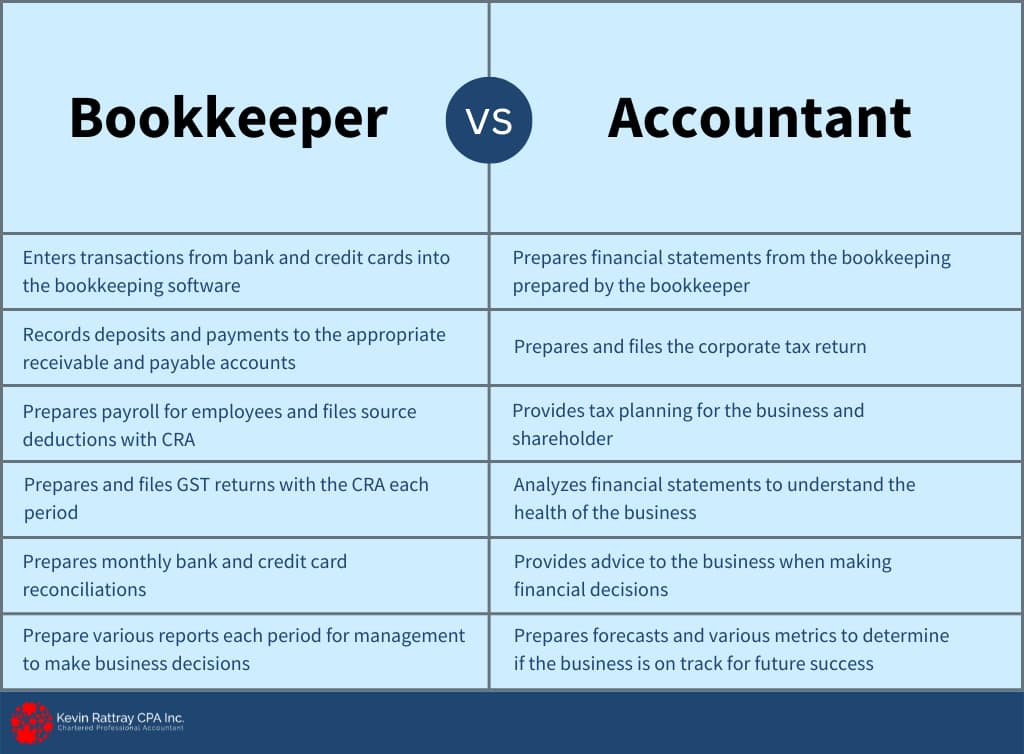
What is the difference between bookkeeping and accounting?
A bookkeeper’s accurate bookkeeping lays the foundation for an accountant to analyze the numbers and provide precise recommendations to the business.
Below is a summary of the different tasks bookkeepers and accountants do to provide value to a business.
If you’re currently doing your own bookkeeping, check out our blog for helpful tips to keep your bookkeeping organized and on track.
Visit our bookkeeping services and plans pages to learn more about how we can assist you in reaching your goals. They provide an overview of our services, including information on the benefits and features of each. Feel free to contact us if you have any questions about our services.
Disclaimer
The author takes reasonable care to ensure that the information on this blog is complete at the time it was posted. The information may not be comprehensive or current and is provided for general information purposes only.
This blog is not meant to be an alternative to professional advice. You should always consult a professional to obtain advice on your situation.