
RRSP Or TFSA: What’s The Best Way To Save Your Money?

Contents
Share
Registered Retirement Savings Plans (RRSPs) and Tax-Free Savings Accounts (TFSAs) are two of Canada’s most popular investment vehicles. They offer Canadians several benefits, including tax savings and the ability to grow their money either on a tax-deferred basis or tax-free. So, which one is best for you? This blog post will compare RRSPs and TFSAs and help you decide which is best for your needs!
What is an RRSP?
A registered retirement savings plan (RRSP) is a savings plan that is registered with the Canadian government. Contributions to an RRSP are tax-deductible, and any earnings on your investments grow tax-deferred until you withdraw the money in retirement. Withdrawals from an RRSP are taxed as income in the year they are taken out.
Highlights of an RRSP
Lifelong Learning Plan
The lifelong learning plan (LLP) is a federal government program that allows you to withdraw money from your RRSP to pay for full-time training or education for yourself, your spouse, or your common-law partner. You can withdraw up to $10,000 in a calendar year and $20,000 in total from your RRSP under the LLP, and you have up to ten years to repay the amount withdrawn.
Home Buyers Plan
The home buyers plan (HBP) is a federal government program that allows you to withdraw money from your RRSP to help pay a down payment on your first home. You can withdraw up to $35,000 from your RRSP under the HBP, and you have up to fifteen years to repay the amount withdrawn.
Group RRSP
If you are part of a group RRSP where you work, contributing to your RRSP may be more beneficial than a TFSA, even if you’re in a low tax bracket. Some employer match employee contributions with these plans, making them more attractive than TFSA contributions.
When an employer matches contributions, the amount they contribute is added to your employment income as a taxable benefit, so at the end of the year, you’ll receive an RRSP contribution slip with both your contributions and the contributions your employer matched. This is then included on your tax return to reduce your annual income.
Conversion to a Registered Retirement Income Fund (RRIF)
An RRSP needs to be converted to a RRIF by the end of the year you turn 71. Once converted to a RRIF, you can no longer contribute to your account.
In addition, you must withdraw a minimum amount from your RRIF each year after it’s been converted from an RRSP.
Government Benefits and Tax Credits
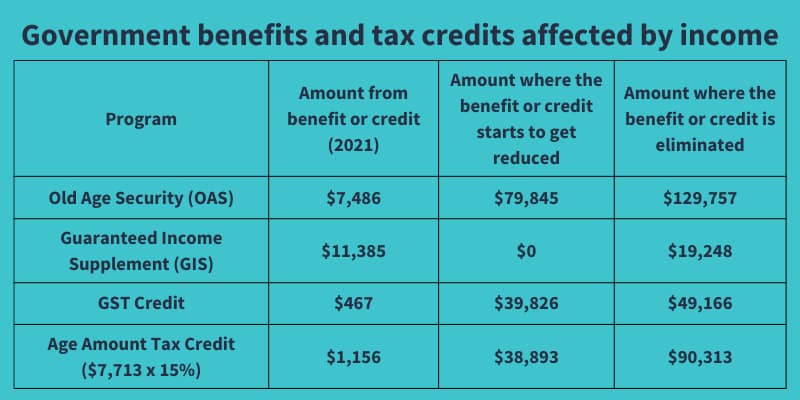
Because withdrawals from your RRSP or RRIF are considered income, they can reduce the amounts you get from government programs and tax credits.
The following programs and tax credits are tied to your income amounts and start to get reduced over certain income levels and eventually get eliminated if your income is too high.
RRSP Contribution Room and Withdrawals
Your RRSP contribution room is based on your previous year’s earned income. Earned income comprises your employment income, net income from self-employment, net income from property income, and other income sources.
The contribution limit for RRSPs is 18% of your previous year’s income, up to $29,210 for 2022.
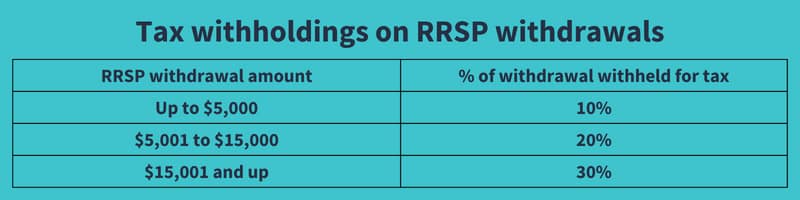
You can withdraw your money from your RRSP if needed. However, if not for the LLP or HBP, taxes will be withheld on the withdrawal and remitted to the Canada Revenue Agency (CRA). In addition, you will lose that contribution room permanently.
Tax is withheld as follows:
Over contributions are taxed at 1% per month on the overcontributed amount. There is an allowable lifetime overcontribution amount of $2,000, so an overcontribution would be taxed if it was more than your RRSP deduction limit plus $2,000.
Eligible Investments
You can hold various investments in an RRSP, including stocks, bonds, mutual funds, and exchange-traded funds (ETFs). You can also hold cash in an RRSP, although this is not typically recommended as it will not grow much over time.
You can find a more detailed list of qualified RRSP investments here.
You can also hold foreign investments in your RRSP.
Foreign stocks usually have at least a 15% withholding tax on dividends, which will reduce your returns on these investments. However, depending on the country the foreign investment is in, a tax treaty may provide relief to recover the withholding tax.
The tax treaty between Canada and the U.S. recognizes an RRSP as a trust and exempts dividends and interest from taxation.
RRSP Refund
RRSPs are tax deductible so that you can deduct the amount of your RRSP contributions in the year from your income. This means you may get a tax refund depending on your other income and deductions.
The refund you receive from contributing to your RRSP will depend on your marginal tax rate. So, your refund will depend on how much taxable income you earn in the year.
If possible, the best strategy for your tax refund is to put it in your RRSP or TFSA. Your refund will eventually need to be paid back to the CRA when you withdraw money from your RRSP. The problem is that your RRSP contributions will grow over time, so your tax refund should also grow to pay tax on both the original contribution and the income earned over the years.
What is a TFSA?
A Tax-Free Savings Account (TFSA) is an investment account that allows Canadians to earn tax-free investment income. Contributions to a TFSA are not tax-deductible, but any earnings on your investments grow tax-free.
Highlights of a TFSA
Government Benefits and Tax Credits
Since income from a TFSA is not reported as income on your tax return, it will not affect any income you receive from government programs such as OAS and GIS and will also not reduce your age amount tax credit or GST rebate.
TFSA Contribution Room and Withdrawals
The contribution room begins to accumulate the year you turn 18. So, if you were 18 in 2009, the year the TFSA account was introduced, you will have a current contribution room of $81,500 if you have never contributed before.
Contribution room is added on January 1 of each year.
Because withdrawals from a TFSA are tax-free, you can access your money anytime without having to pay taxes on it. This means you can use your TFSA account for saving for short, medium, or long-term purposes.
Unlike an RRSP, your contribution room is not lost when you withdraw money from your TFSA. You will, however, need to wait until January 1 of the following year to get the contribution room added back.
Over contributions are taxed at 1% of the highest excess amount during the month until the extra amount is withdrawn from your account.
Eligible Investments
You can hold various investments in an RRSP, including stocks, bonds, mutual funds, and exchange-traded funds (ETFs). You can also hold cash in a TFSA.
Like an RRSP, foreign investments can be held in a TFSA.
However, unlike an RRSP, the tax treaty with the U.S. does not recognize a TFSA as a trust. So, if you hold U.S. investments in your TFSA that pay dividends, there will be a withholding tax on the dividends you receive. Because income in a TFSA is not taxable, you’ll be unable to claim a foreign tax credit to recover the withholding tax.
It would be better to hold dividend-paying U.S. stocks in an RRSP account rather than a TFSA account so you don’t incur withholding tax on those dividends.
You can find a more detailed list of qualified TFSA investments here.
Comparison Between an RRSP and a TFSA
As we’ve discussed above, each of these accounts has different features and can have different outcomes depending on each individual’s situation. Let’s look at some different scenarios to see how they vary.
The Marginal Tax Rate Stays the Same
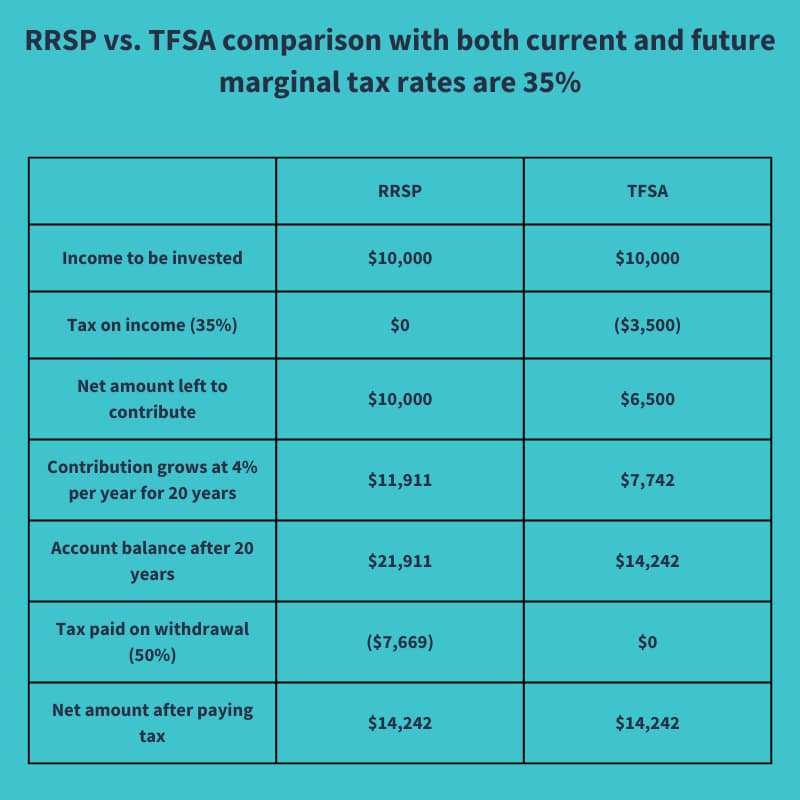
Here, you can see that if your marginal tax rate stays the same between the time you contribute funds to your RRSP or TFSA, neither account has an advantage.
You may be thinking, “What about the tax refund that the RRSP contribution will create?”
Yes, the RRSP contribution can lower taxes owing or may even give you a refund, but it does eventually need to be paid to the CRA at some point in the future when you withdraw the money from your RRSP.
The problem is that your RRSP contribution will grow over time, so the refund you receive now won’t be enough to cover the tax owed on your RRSP investment in the future.
So, what’s the answer?
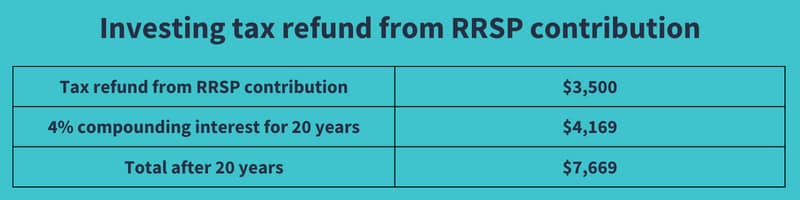
If you’re able, deposit your refund into your RRSP or TFSA so that it can also grow over time. This will give you the cash you need to pay the tax on your RRSP/RRIF withdrawal in the future.
Below, you can see that the refund from the example above would grow to the amount of the tax owing 20 years from now.
Marginal Tax Rate Increases Over Time
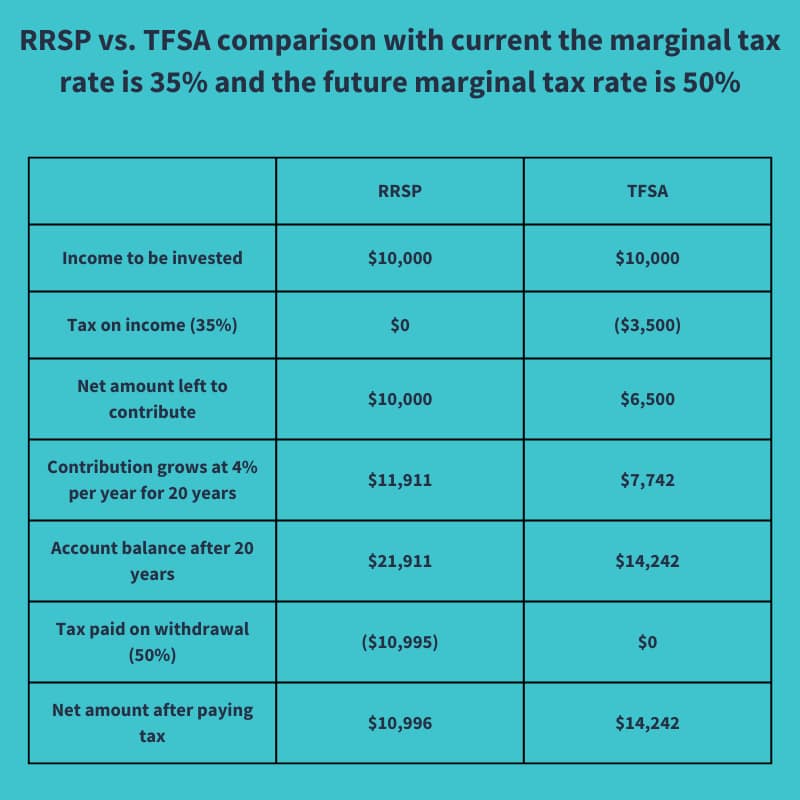
This scenario is what you typically see when you develop throughout your career. Your income grows as you gain experience.
The RRSP option would give you a $3,500 ($10,000 x 35%) refund now, but in the future, when you withdraw the money, your marginal tax rate is higher, meaning you pay more tax.
You would have been better off contributing the money to a TFSA as you would have paid $3,287 less in tax.
Marginal Tax Rate Decreases Over Time
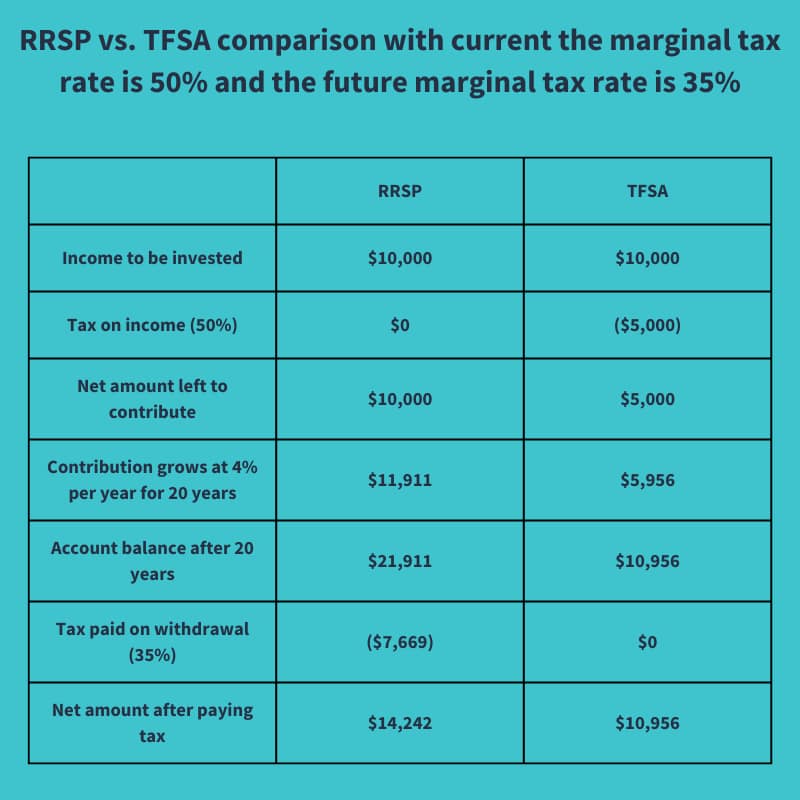
This scenario is where you can see the benefit of the RRSP.
The expectation is that your living expenses will be lower when you retire, so you won’t need as much cash to live on.
Your higher marginal tax rate will result in a more significant decrease in your taxes payable now; you’ll then be able to withdraw that same money in the future at a lower marginal tax rate. This results in the opposite outcome as the previous scenario. The RRSP option results in $3,287 in tax savings compared to the TFSA.
Which Account Should You Contribute to First?
Ideally, if you can afford to, it’s best to maximize your contributions to your RRSP and your TFSA. This allows you to defer taxes on the money you contribute to your RRSP and simultaneously grow your TFSA contributions tax-free.
However, many people are unable to do this, so picking the right account to contribute to can save them a significant amount of money in the long run.
If you expect that your tax rate isn’t going to change in the future, then there is no real financial difference between an RRSP and a TFSA account.
If your marginal tax rate is currently low, but you expect it to increase, a TFSA could be the better option since RRSP contributions are less effective at lower tax rates.
Finally, if you expect your marginal tax rate in retirement to be lower than it is now, contributing to an RRSP could be most beneficial. Your RRSP contributions will save you more tax now than you will owe on that same money when you withdraw it in the future.
These scenarios are basic examples to show how changes in marginal tax rates can affect the outcomes of contributing to RRSP and TFSA accounts. The best option will ultimately depend on each individual’s situation.
Visit our personal tax services and plans pages to learn more about how we can assist you in reaching your goals. They provide an overview of our services, including information on the benefits and features of each. Feel free to contact us if you have any questions about our services.
Disclaimer
The author takes reasonable care to ensure that the information on this blog is complete at the time it was posted. The information may not be comprehensive or current and is provided for general information purposes only.
This blog is not meant to be an alternative to professional advice. You should always consult a professional to obtain advice on your situation.