Taxable Benefits In Canada: What You Should Know As An Employer

Contents
Share
If you have employees, it's important to know what a taxable benefit is and how they are reported to ensure source deductions and T4's are correct. This also applies to shareholders that receive benefits through the business.
We'll take a look at some of the more common taxable benefits in Canada and how to report them.
What Are Taxable Benefits?
Taxable benefits are allowances, payments, or products/services given to an employee that are personal in nature. These benefits need to be reported as part of the employee's compensation on their T4 and may need to have CPP, EI, and income tax deducted.
Employers' Responsibility
As an employer, you are responsible for determining if taxable benefits were received by your employees, the value of the benefit, determining the payroll deductions on the benefit, and to report the benefit on the employee's T4 slip.
Cash vs Non-Cash Taxable Benefits
Cash taxable benefits are where the employer pays cash directly to the employee. The benefit can be paid either by direct deposit, cheque, or currency.
Non-cash taxable benefits are where the employer pays for a product or service then gives it to the employee. An example would be an employee receiving a laptop computer as a gift from their employer. Since the computer was given to the employee rather than cash, it would be considered a non-cash taxable benefit.
It is important to understand these differences since CPP and EI deductions can differ depending on if taxable benefits are cash or non-cash.
Vehicle Benefits
Personal Use Of A Business Vehicle
If you have an employee that has access to a business vehicle and uses it to drive to and from work and for other personal activities, then there is a taxable benefit to the employee.
A logbook should be used to track the business travel for the year so employees' taxable benefits can be calculated accurately. The date, destination, purpose, and the distance travelled for each trip should be recorded to show the total distance the vehicle was used for business purposes during the year. This is then used to support the business and personal use of the vehicle if the Canada Revenue Agency (CRA) requests to see the supporting documentation.
Some employers may provide electric vehicles to employees for business use.
Although the operating costs of an electric vehicle may be less than a gas-powered vehicle, the taxable benefit is still calculated the same way for both types of vehicles.
CRA has an automobile benefits calculator you can use to determine the benefit for your employees.
Calculation Of The Taxable Benefit
If an employee or owner-manager has access to a business vehicle that they also use personally, there is a taxable benefit that needs to be calculated and included on the employee's T4.
Standby Charge
A standby charge is a benefit your employee receives when a vehicle purchased or leased by your business is used personally by your employee. If the employee does not use the vehicle for any personal use, then there is no standby charge.
Standby Charge For Employer Owned Vehicles
The standby charge for employer owned vehicles is calculated by:
2% x Cost of the car x Period of availability
Cost of the car – This is the price paid for the vehicle plus GST and PST
Period of availability – This is calculated as the days made available to the employee divided by 30. Days made available is considered to be days that the employee has access and control of the vehicle.
Standby Charge For Employer Leased Vehicles
The standby charge for employer leased vehicles is calculated by:
(2/3) x Lease payments for the year excluding insurance x Availability factor
Lease payments for the year – The total lease payments for the year including GST and PST. Insurance is excluded as CRA considers them part of the operating cost benefit.
Availability Factor – Calculated as (number of days in the year available to the employee/number of days in the year that lease payments were made).
As you can see, the standby charge will always be based on the original cost of the vehicle even though it depreciates each year.
Reduced Standby Charge
A reduced standby charge applies when the employee uses the vehicle for business purposes more than 50% of the time and the employee drives less than 1,667 km per month for personal use.
The calculation for the reduced standby charge is:
Personal use kilometers (cannot be more than denominator)/(1,667 kilometers x number of months available)
Number of months available – This is calculated as the days made available to the employee divided by 30. Days made available is considered to be days that the employee has access and control of the vehicle.
Operating Cost Benefit
The operating cost benefit allocates a portion of the vehicle operating costs to the employee based on a rate per kilometer. For 2022 the benefit is $0.29 per km of personal use.
There are a couple of calculations that can be used to determine the operating cost benefit.
Basic Calculation
The basic fixed rate calculation is calculated as:
$0.29 x number of personal use kilometers
Alternative Calculation
You can use the alternative calculation if all of the following are met:
- A standby charge is included in the employee's income
- The employee uses the vehicle more than 50% for business purposes
- The employee makes a request in writing to use this method prior to the end of the tax year
The alternative method is calculated as:
(1/2) x The standby charge
Taxable Benefit Example
Now we'll take a look at a couple of simple examples. One where a vehicle is used for more than 50% business use and one where a vehicle is used for less than 50% business use.
Both examples will assume the following:
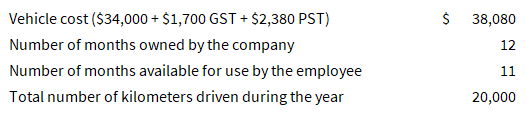
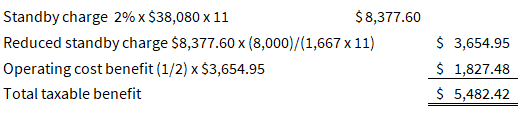
More Than 50% Business Use
In this example the employee used the company vehicle for 8,000 km personally and 12,000 km for business.
We assume that the employee requested in writing that the alternative operating cost benefit calculation be used.
Less Than 50% Business Use
In this example the employee used the company vehicle for 12,000 km personally and 8,000 km for business.

Business Use Of A Personal Vehicle
If an employee uses their personal vehicle to conduct business activities, then they can be given a reasonable allowance that does not result in a taxable benefit. For 2022, CRA's reasonable allowance per kilometre is $0.61 per km for the first 5,000 kilometres and $0.55 per km for every kilometre over 5,000.
However, if they are given an allowance that is not reasonable or a flat rate allowance that is not related to the kilometres driven then the full amount of the benefit is taxable to the employee.
Childcare
Providing childcare for an employee's child is a taxable benefit unless all of the following conditions are met:
- The services are provided at your place of business;
- The services are managed directly by you;
- The services are provided to all employees at minimal or no cost;
- The services are not available to the general public, only to employees.
However, if all of the 4 conditions are not met, the taxable benefit is the fair market value of the services less any amount paid by the employee.
Board And Lodging
If you provide free or subsidized board and lodging to an employee, it is usually considered a taxable benefit. The amount of the taxable benefit would be the fair market value of the board and lodging.
There are a couple of exceptions that can affect the amount of taxable benefit reported. Specific conditions must be met for each of the following exceptions:
- Board/lodging allowances to players on sports teams or members of recreation programs;
- Board/lodging to employees that work at special work sites or remote locations.
Education
If you provide a scholarship, bursary, tuition, or training to an employee it may be considered a taxable benefit to them.
If the employee obtains a degree, diploma, or certificate in an area that benefits the employer by providing the employee with enhanced skills that will be applied in your business then the benefit is not considered taxable to the employee.
However, if the courses taken by the employee were for personal interest and would not benefit the company then the fees paid for these courses are considered a taxable benefit.
In addition, if there was no taxable benefit and the employee did not have to pay the tuition fees themselves, then the tuition fees would not qualify for the tuition tax credit on the employee's personal tax return. In this case, the employee should be notified so they don't file their tax return incorrectly.
Meals
Overtime Meals Or Allowances
If overtime becomes a regular occurrence (at least three times per week) then overtime meals or allowances provided to employees become a taxable benefit.
In order to not be considered a taxable benefit, all three of the following conditions need to be met:
- The allowance needs to be reasonable. CRA considers up to $23 per meal to be reasonable;
- The employee works at least 2 hours overtime right before or right after their normal hours of work;
- The overtime is not frequent. (Less than 3 times per week)
Subsidized Meals
If meals are provided to employees (cafeteria), then there is no taxable benefit as long as the employee pays a reasonable amount that covers the cost of the food, its preparation, and service.
However, if the meal charge is too low to cover the cost of the meal, then the taxable benefit is the cost of the meal less the amount paid by the employee.
Gifts, Awards, And Long Service Awards
Gifts
Employees can receive up to $500 per year in non-cash gifts tax-free. If an employee receives gifts over $500 during the year, then the amount in excess of $500 is considered a taxable benefit.
Cash and near-cash gifts (gift cards) are considered a taxable benefit regardless of the cost.
The CRA has updated its administrative policy regarding gift cards. If a gift card meets all the following criteria, then it is considered non-cash and is not considered a taxable benefit.
- Money is already on the gift card that is given to the employee.
- The gift card can only be used to purchase goods or services from a single retailer or group of retailers identified on the card.
- The terms and conditions of the card state that the balance on the card can't be converted to cash.
- A log is kept of the following information: the employee's name, the date the employee received the gift card, the reason the employee received the gift card, the type of gift card, the name of the retailer, and the amount on the gift card.
This includes gift certificates, chip cards and electronic gift cards. If any of the above criteria are not met, then the gift card is considered a near-cash gift and is a taxable benefit to the employee.
Gifts to employees must be for a special occasion such as a religious holiday, a birthday, a wedding, or the birth of a child.
Awards
Employees can receive up to $500 per year in awards tax-free. If an employee receives awards over $500 during the year, then the amount in excess of $500 is considered a taxable benefit.
Awards must be based on the employees' overall contribution to the workplace; it cannot be a recognition of job performance, which would be considered a reward, not an award, and would be a taxable benefit to the employee.
Long Service Awards
Employees can receive a long service award of up to $500 tax free. This award can be given every 5 years and must be for a minimum of 5 years service. An employee that receives a long service award tax free during the year is still eligible to receive non-cash gifts and awards up to $500 tax free in the same year.
To calculate the value of the gifts, awards, and long service awards, you need to use the fair market value (FMV) of each gift plus GST/HST and PST. The value can't be determined by the cost to the company.
Group Term Life Insurance Policies
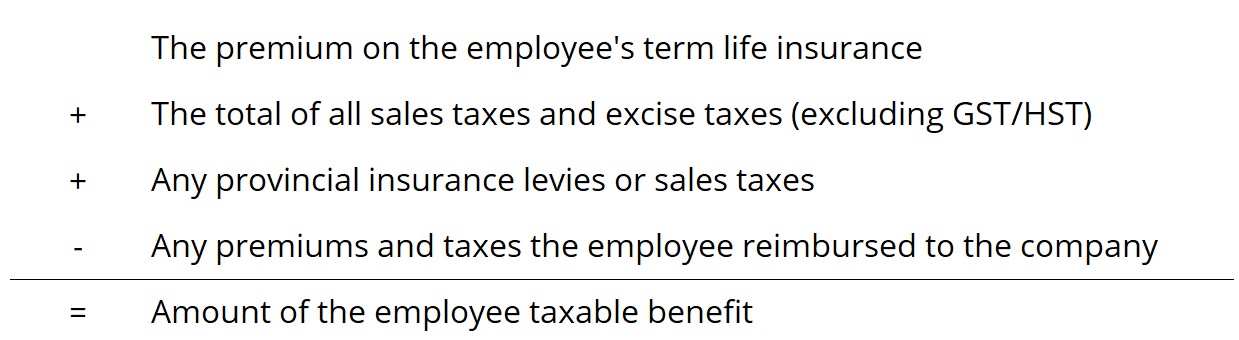
If you pay premiums for a group term life insurance policy for your employees, then the employer paid premiums are a taxable benefit to the employees.
The benefit is calculated as follows:
Group Sickness Or Accident Insurance Plans
Premiums paid for employees Accidental Death & Dismemberment (AD&D) Insurance and Critical Illness Insurance are taxable benefits.
However, if the employee pays 100% of the premiums for these plans themselves, then there is no taxable benefit to the employee and if the plan pays out benefits to the employee in the future, they are not taxable to the employee.
Private Health Services Plan Premiums
Any premiums paid by an employer to an employee's private health services plan such as medical and dental plans, are not taxable benefits for the employees.
If a portion of the premiums are paid by the employee, they can be claimed on their income tax return as medical expenses.
RRSP Contributions
If you make contributions to an employee's RRSP, they are considered a cash taxable benefit. If an amount is withheld from the employee's pay, you will need to make sure the taxable benefit is calculated based only on your company's contribution.
However, if the contribution is to a group RRSP where the employee can't withdraw contributions from, other than for the lifelong learning plan and home buyers plan, it is a non-cash benefit.
Although it is a taxable benefit, tax does not have to be withheld if you have reasonable grounds to believe the employee can use the contribution to reduce their taxable income for the year.
If any RRSP administration fees paid for the employee have GST included in them, then the GST would be included in the benefit.
GST On Taxable Benefits
Depending on the benefit, you may be required to remit GST/HST on the benefit provided. The value of the GST/HST will be included in the amount of the benefit recorded on your employee's T4 and you will have to claim the value of the GST/HST on your GST return.
You are considered to have collected GST/HST at the end of February in the year following the year the employee received the taxable benefit. This coincides with the employee receiving their T4 for the previous year.
CPP And EI On Taxable Benefits
You may be required to deduct CPP contributions and EI premiums depending on the taxable benefits you provided to your employees.
CRA's benefits and allowances chart provides a comprehensive list of taxable benefits and whether CCP and EI need to be deducted, if GST is included, and which tax code to use on the employee's T4 slip.
Visit our payroll services and plans pages to learn more about how we can assist you in reaching your goals. They provide an overview of our services, including information on the benefits and features of each. Feel free to contact us if you have any questions about our services.
Disclaimer
The author takes reasonable care to make sure the information on this blog is complete at the time it was posted. The information may not be comprehensive or current and is provided for general information purposes only.
This blog is not meant to be used as an alternative to professional advice. You should always consult with a professional to obtain advice on your specific situation.