Important Things To Know About Your Corporate Income Tax Return
Contents
Share
Filing your corporate income tax return is probably one of the last things on your mind when trying to juggle so many tasks within your business. However, missing filing deadlines can create additional costs with interest and penalties and refunds could be lost if you wait too long to file your corporate income tax return. You should also be aware of tax credits your corporation may qualify for which could reduce taxes payable.
CRA Deadlines For Corporate Income Tax Returns
If you have an incorporated business, you will need to file a corporate income tax return each fiscal year. The deadline for filing the T2 return is 6 months after the fiscal year end and the deadline for paying corporate tax will be either 2 or 3 months after the fiscal year end depending on your corporation's status.
Additionally, if you are expecting a refund, you will want to file your corporate income tax returns within 3 years of the fiscal year end. Under subsection 164(1) of the Income Tax Act overpayments are statute-barred for refund purposes after 3 years. However, if you find yourself in this situation you can file a request for re-appropriation of the credits. If allowed, you won't be able to receive the refund, but it can be used against a future outstanding debt with CRA.
Paying Corporate Taxes
If your corporation owes taxes, there are several ways to pay the CRA including: online, credit card, PayPal, Interac e-transfer, and at your financial institution. Click here to see a full list of payment options.
CRA Interest And Penalties
Failing to file your corporation's income tax return each year can be very costly so it's important to have bookkeeping kept up to date and documents provided to your accountant promptly to ensure your tax return is filed on time.
CRA Late Filing Penalty
If your corporate income tax return is filed late and there is a tax balance due, then CRA assesses a late filing penalty of 5% on the unpaid tax. In addition, for every full month the return is filed late there is an additional 1% penalty on the unpaid balance to a maximum of 12 months.
CRA Interest
The CRA charges an annual interest rate on overdue taxes. Currently this rate is set at 5% annually. CRA's prescribed interest rates are updated quarterly.
T1135 Late Filing Penalty
If your corporation owns specified foreign property costing more than $100,000 it will need to be reported on the T1135 form on the corporate income tax return.
Form T1135 must be filed within 6 months of the corporation's fiscal year end. If form T1135 is filed late, the penalty is $25 per day for up to 100 days. The minimum penalty is $100, and the maximum penalty is $2,500.
Voluntary Disclosure Program
If you've missed the T2 return or T1135 deadline, CRA's voluntary disclosure program may be able to provide relief. Should the CRA approve your application, it could provide prosecution relief, penalty relief and partial interest relief.
CRA Instalments
If your business has taxes payable of more than $3,000 in one fiscal year then you will be required to make instalment payments for the next taxation year. These will be monthly instalment payments unless your business meets the eligibility criteria to make quarterly instalment payments.
The first instalment payment is due either at the end of the first month of the fiscal year or the last day of each quarter. The remaining instalments are due on the same day each month or quarter as the first payment was made.
For example, a corporation with a fiscal year end that starts on January 1, 2021 and ends December 31, 2021 would pay their monthly instalments on January 31, 2021 then each month on the last day until December 31, 2021. If the corporation is eligible to file quarterly the instalments would be March 31, June 30, September 31, and December 31, 2021.
CRA will charge interest (currently 5% annually) if you don't make your instalments during the year, or you make insufficient payments. They may also charge an instalment penalty if your instalment interest grows to more than $1,000.
Tax Credits
Depending on the type of business you have, you may be eligible to claim tax credits on your corporate income tax return. Tax credits vary based on province and industry so you should consult with your accountant to determine your eligibility. Click here to see a full list of corporate income tax credits for BC.
Apprenticeship Tax Credits
One tax credit that is sometimes missed is the apprenticeship tax credit. If you have apprentices employed in your business, you may qualify for the Apprenticeship Job Creation Tax Credit or the BC Training Tax Credit. Be sure to provide apprentice information to your accountant so they can determine if you are eligible to claim either credit.
Apprenticeship Job Creation Tax Credit
This is a non-refundable tax credit, meaning you need to have taxes payable in order to use it. The credit is equal to 10% of the eligible wages paid to an eligible apprentice. The maximum credit is $2,000 per year per each eligible apprentice.
The criteria for an eligible apprentice is that they are in the first two years of a prescribed program. A prescribed trade is any trade listed as a Red Seal Trade.
Note: This tax credit is calculated on Schedule 31, parts 19 – 21.
BC Training Tax Credit
This is a refundable credit for taxable corporations with a permanent establishment in BC. Eligible employees need to be registered in a prescribed program with the BC Industry Training Authority.
The following chart lists the eligibility criteria and credit amounts for the BC Training Tax Credit.
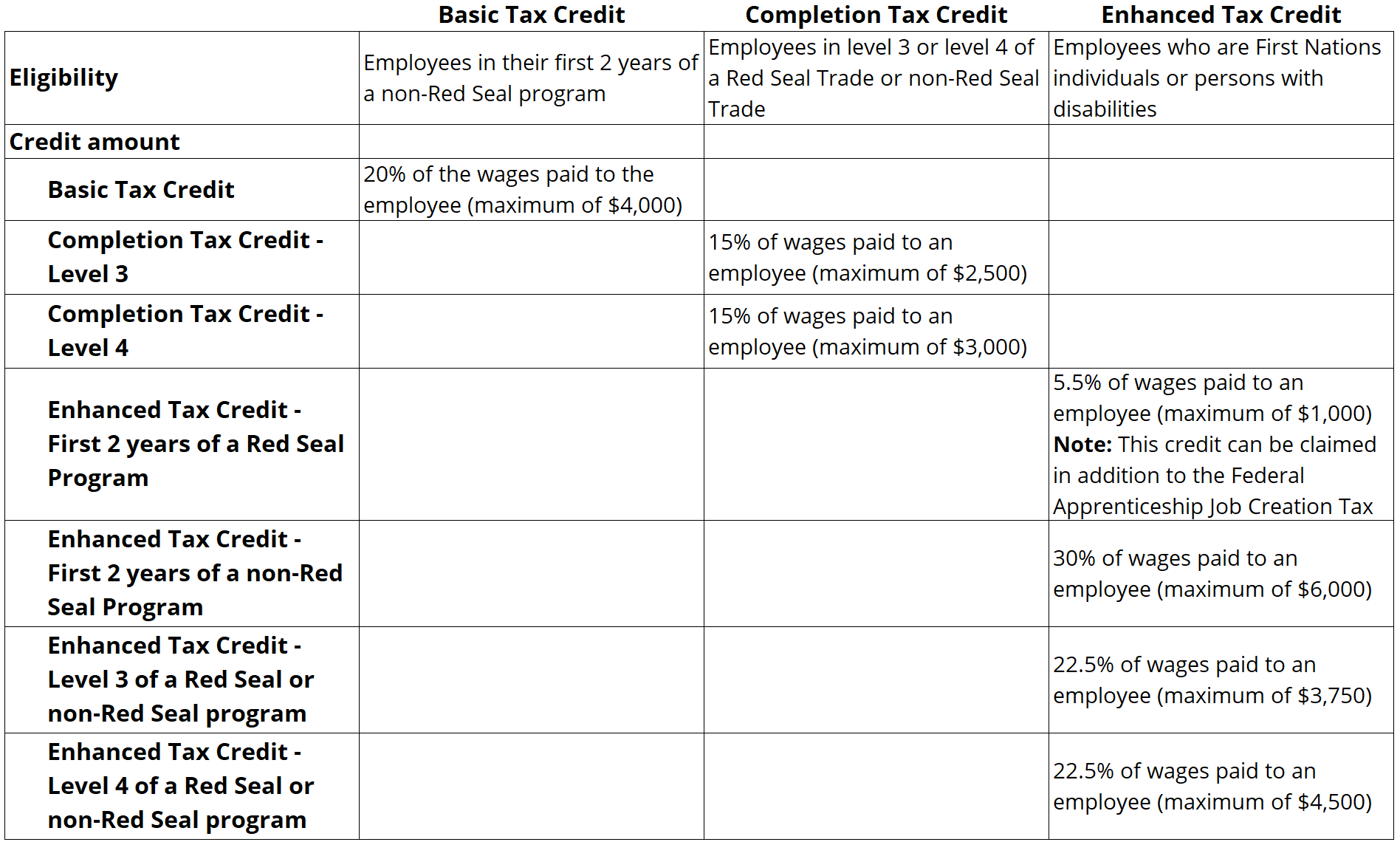
Note: This tax credit is calculated on schedule 428 of the T2 return. In addition, apprentices may also be eligible to claim the training tax credit on form T1014 of their personal tax returns.
Scientific Research & Experimental Development Eligibility
If your company is eligible to claim Scientific Research & Experimental Development (SR&ED) expenditures and investment tax credits (ITC) you will want to make sure all information is submitted to the CRA by the SR&ED deadline. Providing clear and concise information could reduce the time it takes the CRA to approve a claim. If the CRA requires additional information, it is important to provide it before the deadline.
You should set aside adequate time to prepare detailed responses to the required questions on the tax forms.
To find out of your business may have eligible expenses click on the link below to use the CRA tool.
SR&ED Self-Assessment and Learning Tool
SR&ED Deadline
Your SR&ED claim must be filed within 12 months of your tax return due date. (18 months from the fiscal year end). If the SR&ED forms are filed with information missing, the CRA will allow missing information to be provided up to the reporting deadline. However, if the SR&ED forms are filed after the reporting deadline the claim will be denied by the CRA.
Note: SR&ED information is submitted on the following forms:
- Schedule 31 to claim investment tax credits (ITC)
- T661 to claim expenditures
Visit our corporate accounting services and plans pages to learn more about how we can assist you in reaching your goals. They provide an overview of our services, including information on the benefits and features of each. Feel free to contact us if you have any questions about our services.
Disclaimer
The author takes reasonable care to make sure the information on this blog is complete at the time it was posted. The information may not be comprehensive or current and is provided for general information purposes only.
This blog is not meant to be used as an alternative to professional advice. You should always consult with a professional to obtain advice on your specific situation.